
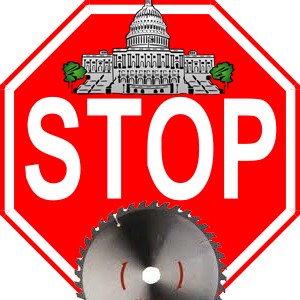
O how I love to rant, I even flexed my photoshop skills for this one and added a custom image. Let me start off by saying SawStop is a great technology, it can save limbs and sometimes lives. If I could afford one I would have one.
Whats going on: SawStop is trying to petition the U.S. government to mandate that all table saws use the SawStop system which would increase the cost of all table saws significantly, reduce their availability and their patents on blade retraction are hampering other saw manufactures from exploring safer technologies and making safer saws.
Who is SawStop? SawStop is a company that invented an innovative technology to stop a saw from contact with a human body part. It works by having a electrical signal around the blade, the human body is conductive so when it disrupts this signal and a spring loaded brake is released that stops the saw instantly.
My 2 cents on the matter: I think the technology is great it saves limbs and lives and I would love to own one, but the cost is way out of reach for me. I am sure it is out of reach cost wise for a huge chunk of our readers. Basically a carpenter will have to fork out hundreds of extra dollars when already material costs are up, fuel prices are up and work is down. I understand that SawStop invented the technology and should get paid, but don’t force it at the expense of the consumer. I understand the SawStop is safe, but I am sure it fires accidentally once in a while, that would cause extra expense and lost downtime to the Tradesman. Table saws have been used for years and yes they are inherently dangerous, but leave that up to the user if they want to fork over the $$$ to be safe. Situations like this suck because everything is in red legal tape wasting $$$ on a product that everyone can benefit from if the cost is right. All the money wasted on lawyers could go to making SawStop more affordable which would give it better chance of showing up on more saws. I am all for SawStop, just don’t force it on me. This is America land of the free and if someone wants to chop off their fingers with a table saw they have the right to. And also because this is America, innovators and capitalists like SawStop give them the option not to lose fingers, at a cost of course. If this law passes, todays saws will be a hot item on Craigslist as everyone will be trying to stock up.
I think it’s crazy that Washington even has a committee on this sort of thing. How about we disband that committee and the money saved there would buy a SawStop for everyone (or pay some of our debt back to China). LOL Politics suck! There should be no government everything should be voted on by the people through the internet! I know that if I were to vote on a $4800 toilet seat I think some people would have a cold ass.

______
FACTS ABOUT TABLE SAW SAFETY STANDARDS
The Power Tool Institute (PTI) is a trade association comprised of the nation’s largest manufacturers of portable and stationary power tools. PTI members have invested hundreds of millions of dollars in an effort to make table saws and other power tools safe when used properly. As a result, injury rates are declining even as saw usage has more than doubled in the past 10 years.
The updated voluntary standard for table saw safety, UL 987, includes new guard designs and other safety features and the results have been positive.
In fact, since 2007, manufacturers have introduced over 800,000 saws with newly designed guards which meet the requirements of the UL 987 safety standard. To date, there have been no reported blade contact injuries on a table saw with the new guard. These new guarding systems are modular and offer excellent visibility and ease of removal and installation. The guards protect the operator from blade contact as well as and injuries caused by thrown objects from kickback.
The Consumer Product Safety Commission (CPSC) is being asked to impose mandatory standards, requiring a specific technology for all table saws. The company petitioning the CPSC to act is SawStop, which is owned by patent attorney Stephen Gass. Mr. Gass, who holds an extensive network of over 70 U.S. patents (with more than 120 patents filed), has represented that SawStop’s patent web would give it a monopoly if the CPSC were to adopt the standard requested in SawStop’s petition. If this is so, the CPSC would be imposing a design standard rather than a performance standard as the Consumer Product Safety Act requires. This proposed standard would generate millions of dollars for SawStop while hurting consumers; undermining the development of new table saw safety technology; and creating a monopolistic advantage for SawStop in the marketplace.
SawStop saws are available to any consumer who chooses to purchase them. SawStop technology is currently available on belt-driven saws such as cabinet or contractor saws. These cabinet and contractor saws constitute 30.6% of saws on the market. SawStop has stated that it hopes to develop a portable bench top saw with SawStop technology that will cost under $1,000. Portable bench top saws on the market today range in price from $99 to $600 for a premium model. While each company would independently establish its own pricing, the price of a current inexpensive saw model could increase in price from $100 to approximately $400 and the price of a current professional benchtop saw model could increase from $500 to approximately $800.
SawStop is demanding an 8% royalty on the retail value of all table saws with its technology, among other onerous terms. If the SawStop CPSC petition were granted, it could be tantamount to the elimination of portable benchtop saws from the market due to the cost of compliance. The increased cost of even the least expensive table saws would result in power tool users resorting to unsafe methods to accomplish cuts normally performed on a table saw.
SawStop is neither appropriate for all table saws nor does it mitigate injuries caused by kickback or ejected material. SawStop’s own data show that operators are nearly five times more likely to contact the SawStop’s saw blade as opposed to an operator of a conventional saw. This increase in the accident rate on SawStop saws is likely due primarily to a user’s decision to use the blade guard less frequently due to a “sense of security” in having the SawStop flesh-sensing technology on the saw. This absence of the blade guarding system will result in an increased rate of facial or eye injuries from high velocity particles ejected by the saw blade as well as injuries caused by workpiece kickback.
PTI encourages the CPSC to work with the power tool industry and others in the table saw community to promote safety through the voluntary standard process. The voluntary standard is already working, has demonstrated positive acceptance by table saw users, and is in the best interest of safety.
June 14, 2011INJURIES
PTI FACTS-AT-A-GLANCE
• The annual averages of all table saw injuries are 38,490 injuries for 2001/2002 and 39,750 injuries for 2007/2008.
• SawStop cannot mitigate fractures and crushing injuries caused by workpiece kickback or loss of vision caused by high velocity particles ejected by saw blade.
• SawStop technology can mitigate only injuries caused by a contact with the blade, therefore, only blade contact injuries should be considered in light of the petition.
• The blade contact injuries identified by CPSC follow-up studies are 28,300 annually for 2001/2002 years and 33,450 annually for 2007/2008.
• The estimated population of all table saws on the market in US for 2001/2002 was 8.0 million and for 2007/2008 was 9.5 million.
• The blade contact injury rate for all table saw categories combined, for 2001/2002 years and for 2007/2008 years are unchanged.
• Portable bench saws account for only 11% of the accidents although they comprise 69% of table saw population in 2008. These also are the low cost saws Stephen Gass has claimed are dangerous and should be removed from the market.
SOCIETAL COST OF BLADE CONTACT TABLE SAW INJURIES
• For 2001/2002 CPSC estimated annual cost of all table saw injuries was $2 billion. • The percentage of injuries requiring hospitalization was 6.7%. In most cases, the victim was
examined or treated and released from the hospital on the same day. • Dr. John Graham, Dean of the Indiana School of Public and Environmental Affairs, hired by
advocates of SawStop technology to make an economic evaluation of table saw injuries has concluded that an average table saw blade contact injury in 2001/2002 was $22,917. Based on Dr. Graham’s Injury Cost Model, the societal cost of 28,300 blade contact injuries for 2001/2002 is $648.5 million annually, significantly less than the CPSC estimate.
• Dr. Kip Viscusi, a Professor of Economics at Vanderbilt University hired by a table saw manufacturer, estimates a range of societal costs attributable to table saw blade contact injuries for 2001/2002 to be approximately $62,000,000 per year at the low end and approximately $220,000,000 per year at the upper end. Even at the upper end, this is 10% of the figure being used by the CPSC.
PATENTS
• Stephen Gass, a patent attorney, has filed more than 120 U.S. patent applications, and has over 70 issued U.S. patents which pertain to the SawStop technology.
• Stephen Gass told the U.S. government that it should assume that no manufacturer will be able to introduce injury mitigation technology that does not infringe on his patents.
• After the PTI-JV technology became known, SawStop amended one of their then-pending patent applications to purportedly cover any table saw that retracts the blade rapidly within 14 milliseconds – using any retraction technique after detecting contact. This patent
6/11
application which was subsequently allowed by the U.S. Patent Office, is arguably not limited to SawStop’s blade brake technology for retracting the blade, but rather is designed to cover any retraction technique, hindering the development of alternative blade retraction technologies and blocking competing inventors from using their own inventions.
ROYALTIES / LICENSING
• At one time SawStop approached table saw manufacturers offering to license its patent portfolio technology demanding an 8% royalty on the retail value of all table saws with the technology in addition to other terms that were onerous and would have resulted in millions of dollars being paid to SawStop.
• Recently, a table saw manufacturer that is not a member of PTI tried to license SawStop’s patent portfolio technology but negotiations failed when the manufacturer alleged that SawStop demanded unreasonable royalty in excess of what was originally being sought. Gass has indicated he is unlikely to reach agreement on licensing terms in the absence of CPSC action since his business would be hurt unless royalties sufficiently offset his losses.
SAWSTOP
• SawStop is currently available in the marketplace to any consumer who chooses to purchase it.
• Activation of SawStop brake results in additional costs to owner of new blade ($30-$90) and new break cartridge ($69).
• To date, SawStop has not developed a saw for the largest segment of the table saw market – consumer, bench top-style saws.
UNINTENDED CONSEQUENCES OF THE SAWSTOP TECHNOLOGY
• Data supplied by SawStop concerning the number of table saw units sold and the number of reported blade contact incidences, proves that operators are nearly five times more likely to contact the saw blade of a SawStop saw as opposed to the operator of a conventional table saw.
• Logic dictates that this increase in accident rate on SawStop saws is due primarily to a user’s decision to use the blade guard less frequently due to a “sense of security” in having the SawStop flesh-sensing technology on the saw.
• The absence of the blade guarding system will result in increased rate of facial or eye injuries caused by high velocity particles ejected by saw blade or injuries caused by workpiece kickback.
• The increased cost of even the least expensive table saws, as discussed below, would result in power tool users resorting to unsafe methods to accomplish cuts normally performed on a table saw.
COSTS OF TABLE SAWS
• •
SawStop has stated that it hopes the portable bench top saw with SawStop technology will cost under $1,000. Portable bench top saws on the market today range in price from $99 to $600 for a premium model.
Stephen Gass continues to claim the saw brake technology adds about $100 to the retail cost of a saw. However, in legal proceedings, Stephen Gass has admitted that the additional
6/11
• •
components and the re-design of the saw would increase the cost of the table saw by $100-
$150 at the wholesale and not at retail level. A current inexpensive saw selling for $100 could increase to approximately $400 and a
current professional benchtop saw selling for $500 could increase to approximately $800. Included in the costs are the current cost of the saw, redesign and additional components at
retail and 8% royalty. Actual mark up from wholesale to retail will depend on each individual company’s pricing policy.
ALTERNATIVE TECHNOLOGY
• A PTI JV has developed a flesh sensing technology that reacts faster, has a lower replacement cost of firing, and mitigates injury to a greater degree when compared to the SawStop technology. SawStop has stated that the JV system likely will infringe its patents. In light of this situation, manufacturers have to take this into consideration knowing that introducing this technology will result in costly patent infringement litigation (estimated to be at least 7-10 million dollars for each party) with uncertain outcomes.
IMPROVEMENTS IN GUARDING
• Since 2007, PTI members have introduced over 800,000 saws with newly designed guards which meet the requirements of UL 987 safety standard. Table saws meeting these requirements are considered safe for their intended use.
• To date, there have been no reported blade contact injuries on a table saw with the new guards.
• These saws now require a riving knife and feature a new modular guarding system that offers excellent visibility and ease of removal and installation.
• The guards protect the operator from blade contact and injuries caused by thrown objects from kickback. SawStop protects from only blade contact injuries.
STATUTORY REQUIREMENTS APPLICABLE TO CPSC MANDATORY STANDARD
• Section 7(a) of the Consumer Product Safety Act, as amended, requires that in order for the CPSC to impose a mandatory standard, such standard must be reasonably necessary to prevent or reduce an unreasonable risk of injury.
• Section 7(b) of the Act provides that the CPSC cannot impose a mandatory standard if compliance with a voluntary standard would eliminate or adequately reduce the risk of injury and it is likely that there would be substantial compliance with such voluntary standard.
• As described above, the voluntary standard for table saw safety, UL 987, recently has been updated to include new guard designs and other safety features and the results have been positive.
• Section 7(a) of the Act restricts the CPSC to adopting performance standards. • Mr. Gass has represented that SawStop’s patent web would give it a monopoly if the CPSC
were to adopt the standard requested in SawStop’s petition. If this is so, the CPSC would be
imposing a design standard rather than a performance standard as the Act requires. • If the SawStop petition were granted, it could be tantamount to a ban of the portable
benchtop saws due to the cost of compliance described above. • Under Section 8 of the Act, CPSC can only ban a product if it presents an unreasonable risk
of injury and no feasible consumer product safety standard under the Act would adequately protect the public from the unreasonable risk of injury.
6/11


you said “All the money wasted on lawyers could go to making SawStop more affordable and mature the product a little like add blade guards and a way to prevent kickback.”
Add blade guards and a way to prevent kickback? What about the blade guard that comes with every sawstop saw? And the riving knife for use when the blade guard would prevent a cut from being made? Both reduce kickback. Both are supplied with SawStop saws. And you can switch from one to the other in 20 seconds.
Just an extremely satisfied customer.
Thank you for pointing that out Scott I made the correction. You are right the newer SawStops have the guards, The SawStop itself is a great saw from what I hear and I love the innovative thinking behind it. A Finger to me is well worth the price of the saw, I just don’t want to be forced to spend the money to go this route. When the technology progresses and gets cheaper, sure go ahead and pass it into law. The argument here is principle not the saw itself, its more bureaucratic red tape where the user loses out of his or her pocket book and does not have a choice. The only ones getting wealthy here are lawyers.
Its like parachute companies petitioning that you wear a parachute on every flight? because it will save your life!
The retraction mechanism can be disabled on a Saw Stop if you plan to cut into significantly wet wood. I would strongly suspect that the first time your average person/contractor drops $100+ for mechanism and new blade because the sensing tech over-reacted, they will disable the mechanism thereby entirely defeating the official purpose of forcing this technology onto the user. Of course, the unofficial purpose ($$$$), will have already succeeded by then.
The Idea is good. I currently use 4 table saws for my jobs and to replace them at a high cost would really hurt me financially. I hope this doesn’t go through
Right on, right on. I am tired of government gettinginto everything. i depend on my saw for a living and have for years. When my current saw goes, I need to be able to afford a new one. Yes i like the safety feature of the sawstop, but I don’t want it. I want a saw that cuts and i don’t have to worry about replacing any other items except the bursches and maybe the motor. I see why Sawstop is doing this, because there is big money for them. The idea is great, but don’t make me pay for something i don’t want. The government all ready stepped in and took away the happy meal in California, now McDonalds is making my kids fries smaller and they include apples. I take my kids to mcDonalds for a treat, he eats enough apples at home. So I am asking, don’t take away my happy meal also.
I, as a rule, hate all the ‘nanny’ laws.
Yes, seat belts, helmets, air bags, etc save lives, but making all these products mandatory is ridiculous. I do not drive my car in a manner that I’d ever deploy an air bag, for this reason I’d prefer to save the several thousand dollars by having my vehicle not have the air bags.
Likewise, I do not take chances with my table saw. I do not have my hands any where near the blade, but instead use a push stick or other item to keep me safe. I can only hope that the ‘committee’ is wise enough to see what the real item is to this ajenda is and that is GREED.
One only has to look at the one item that everyone uses that the government and bureaucrats turned into a useless, nonfunctional, leaky device – the CARB fuel can – to know just where this will end up.
Well then there’s that patent thingy. The US Patent Office is bordering on the ridiculous anymore. I mean really any device that retracts a blade within blah, blah, blah is a patentable process? A patent is suppose to be a documentable process with specific parts and functions not some touchy feely idea.
The Patent System is so out of whack anymore. Places like Google are actually just writing patents to prevent people from creating new things at the same time there’s a whole new industry that’s been born around patent collections where they go out an buy up patents with their whole intent being to resell them or claim on them.
The pharmaceutical industry has bastardized it as well. They come out with Drug A and when that patent is about to expire they add a sustained release to Drug A to get another 20 years or they change one molecule and claim it’s a new improved medication more than likely you won’t even notice any difference. Sustained release is not a new concept either, it’s been around for a long time so incorporating it into existing medications shouldn’t be any reason for a new patent. Sustained release should’ve been it’s own patent 60 years ago.
But I digress. I use to believe in the patent system but now it’s just another way to rip people off and I think that we have to come up with a better system. Maybe a percentage of profits go back to the original inventor for a period of time when someone creates a better mousetrap rather than preventing someone from building a better mousetrap. Consumers are literally losing their lives when they could have much better products at cheaper prices that are saving or improving their lives.
well said